Let’s start with a question that’s quietly becoming more important than SEO:
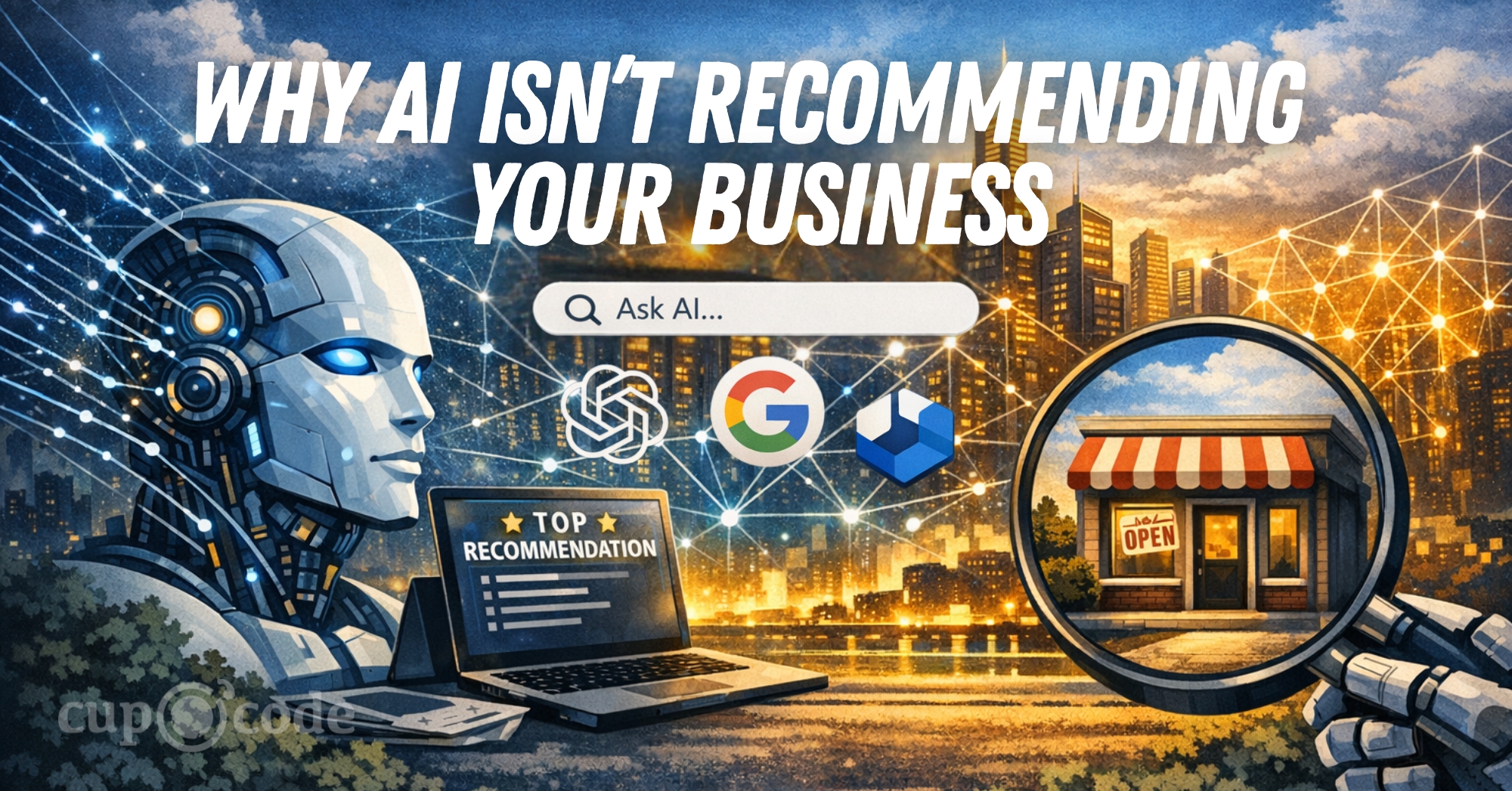
What happens when people stop searching and start asking?
Instead of typing into Google, more people are turning to tools like ChatGPT, Google’s Gemini, Microsoft CoPilot and other AI platforms to get direct answers.
Not links. Not pages. Answers.
And those answers are coming from somewhere.
The real question is why does AI recommend some businesses and not others?
The Shift from Ranking to Referencing
Traditional SEO was about ranking on a page. AI changes the game.
Now it’s all about being cited, summarized and trusted as a source.
Your website isn’t just competing for clicks anymore. It’s competing to be used by AI.
Here’s how to improve your chances of showing up in an AI chat:
- Answer real questions directly
- Create clear, authoritative content
- Use structured, easy-to-read formatting
- Write specifically, not generically
- Build consistent credibility across the web
- Focus on content that resonates, not just keywords
1. Write Like You’re Answering a Question (Because You Are)
AI tools are trained to respond to questions. So, if your content doesn’t clearly answer questions, it’s less likely to be used.
Instead of writing:
“Our services are designed to optimize digital performance…”
Write:
“How can a small business get more leads from their website?”
Then answer it directly. Clear, structured answers are far more usable for AI systems.
2. Authority Matters More Than Ever
AI doesn’t just pull random content. It gravitates toward sources that appear consistent, credible, and referenced across the web.
This includes backlinks, mentions on social media, and overall brand presence. Google’s concept of E-E-A-T (Experience, Expertise, Authority, Trust) still plays a role here.
The stronger your authority signals, the more likely AI is to trust and use your content.
3. Structure Your Content for Machines and Humans
AI favors content that’s easy to extract.
That means clear headings and structure, simple formatting, concise explanations, and logical flow. Shorter, easy to understand sentences are preferable to complex sentences and excessive detail. Messy, dense paragraphs are harder to interpret.
Clean structure increases usability, and usability increases your chances of being referenced.
4. Be Specific (Generic Content Gets Ignored)
AI doesn’t need more generic advice. It already has plenty of that.
What it needs is specific insights, unique perspectives, real life examples, and clear explanations.
Instead of saying “improve your website,” say “add a clear call to action above the fold so visitors know what to do within five seconds.”
Specificity builds usefulness. Usefulness builds visibility.
5. Consistency Across Platforms Matters
AI doesn’t just look at your website.
It looks at your presence across the World Wide Web including business directories, social platforms, professional networks, and mentions.
If your messaging is inconsistent, it weakens trust. If it’s aligned, it strengthens credibility.
Every place your business appears is another signal that says this is real and reliable.
6. The Human Factor (Still Matters Most)
AI is getting smarter, but it still prioritizes content that resonates with humans when recommending businesses.
If your content is helpful, clear, honest, and well written, it naturally becomes more usable for AI. Choose content that real humans would find interesting and useful, and write it in a way that they can understand.
Trying to game the system with tactics like keyword stuffing usually backfires.
Because AI isn’t just looking for keywords. It’s looking for meaning.
Wrapping It Up: Be Worth Referencing
Getting AI to recommend businesses isn’t about tricks. It’s about becoming a source worth using. That means answering real questions, building real authority, and writing for clarity.
Because in this new AI-driven landscape, the businesses that win won’t just be the ones who rank.
They’ll be the ones who are remembered, referenced, and repeated.
For more insights on where websites, SEO, and AI are heading, read our blog on “2026 Guide to AEO.”