(and Why You Shouldn’t Trust Anyone Who Does)
One of the hardest conversations we have with new clients here at Cup O Code is:
“This takes time.”
We get it! “Be patient” isn’t what most people want to hear when they’re investing their hard-earned money into marketing. So when someone else says, “We’ll get you results overnight”… it’s tempting to believe them.
But here’s the truth:
If someone promises instant results, they’re either oversimplifying… or setting you up for disappointment when you realize this type of marketing isn’t sustainable.
The Unsustainability of “Instant”
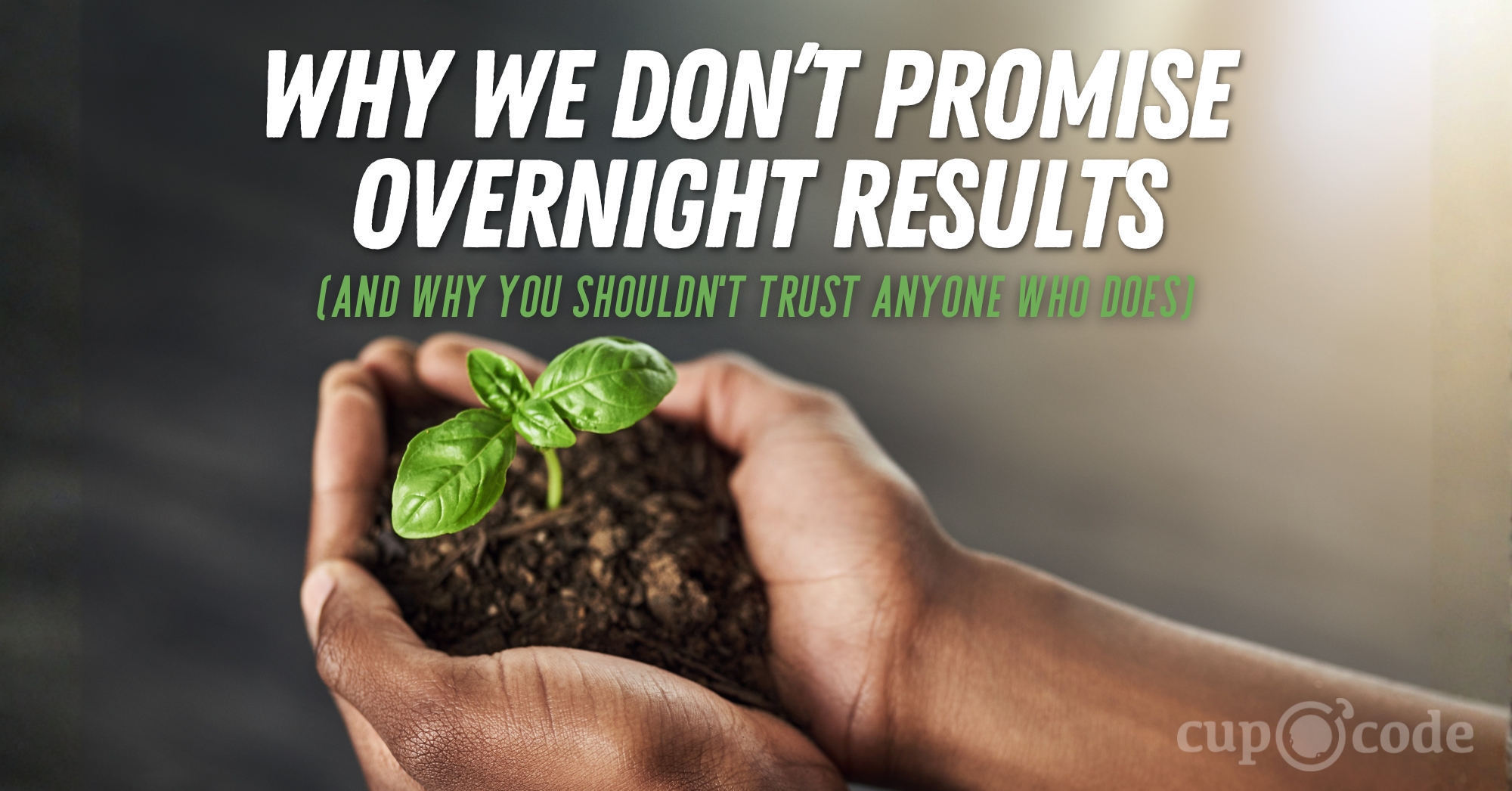
Imagine planting a seed. You water it once, and the next day, you expect a fully grown tree. Sounds ridiculous, right?
Yet, that’s exactly what “overnight results” in marketing promise.
We’re living in a “want it now” world.
It’s a world where you can click a button and have almost anything delivered to your door in two days or less. Where you can Google just about any question and get an answer in seconds. And in some cases, you can even see rapid physical changes from medical treatments designed to produce quick results.
Everything around us has trained us to expect speed.
But there’s a pattern that often gets missed: In almost every “fast results” scenario, there’s a tradeoff.
Fast delivery can lead to impulse decisions and lower-quality products. Instant answers can discourage deeper thinking. And quick physical changes without long-term behavioral shifts don’t often last once the intervention stops.
Marketing is no different.
Because while fast results are absolutely possible… they’re not always sustainable.
The Reality: Platforms Need Time to Learn
Platforms like Meta and Google don’t just “run your ads.”
They learn from them. To do this, they need time to absorb, adapt, and grow.
When you launch a campaign on one of these platforms, or when you make major changes, the system enters what’s commonly referred to as its learning phase.
During this time of learning, it’s actively testing and figuring out:
- Who responds to your ads
- What messaging works
- Where and when to show your content
It does this by testing different combinations and analyzing real user behavior.
And here’s the important part:
Until enough data is collected, performance is naturally less stable.
The system is designed to experiment and analyze to find the best results, which is why performance can fluctuate early on, just like a seedling that hasn’t yet taken root.
What Meta Actually Says
Meta’s own system (inside Ads Manager and its Help guidance) makes a few things clear:
- There is a defined “learning phase” when ads are first launched or significantly changed
- The system is testing audiences, placements, and delivery to improve results
- Performance is less stable during this time
- It typically needs enough conversion data (around 50 events) to stabilize delivery
- Significant edits (budget, audience, creative) can reset this learning process
In plain English:
The platform is figuring out who your customers are, and it can’t do that instantly.
Why “Fast Results” Can Be Misleading
Let’s be clear: getting quick results isn’t the problem. Keeping them going is.
Think of It Like Hiring a New Employee
When you bring on a new employee, they don’t instantly know:
- Who your best customers are
- How your business works
- What makes someone say yes
So what do they do?
They try things.
They learn.
They improve over time.
What “Fast Results” Look Like in This Scenario
Now imagine this:
On their first day, they close a deal.
Great, right?
But why did it happen?
- Maybe that customer was already ready to buy
- Maybe it was an easy win
- Maybe it was luck
That’s what “fast results” often are in marketing:
Early wins from the easiest opportunities.
Here’s Where It Goes Wrong
Now imagine every time that employee starts to figure things out… you say:
- “Try a completely different type of customer”
- “Change how you sell”
- “Start over with a new approach”
What happens?
They never improve.
They stay stuck in trial-and-error mode.
That’s Exactly What Happens With Ads
When you:
- Change targeting too often
- Swap creatives too quickly
- Adjust budgets aggressively
- Pause and restart campaigns
You’re not optimizing. You’re restarting.
And according to how these systems are built, major changes force the platform to re-enter its learning phase, meaning it has to re-test and re-figure out what works.
What This Actually Causes (In Real Terms)
When the system keeps resetting:
1. Costs Stay Higher Than They Should Be
Because the platform hasn’t identified the most efficient audience yet
2. Results Stay Inconsistent
Because it’s still testing instead of refining
3. Performance Never Compounds
Because it never gets past the “figuring it out” stage
Or said simply:
The algorithm isn’t failing—it’s learning. The problem is when we don’t let it finish.
What You Should Expect Instead
Instead of overnight success, real growth tends to look like this:
Week 1–2:
- Data collection
- Testing phase
- Some inconsistency
Week 3–6:
- Improved efficiency
- More stable results
- Clearer patterns
Month 2+:
- Scalable, repeatable performance
- Stronger ROI
- Confident decision-making
It’s like watching a plant grow. At first, it’s slow. You might not see much happening above the surface. But underground, the roots are spreading, anchoring the plant, and preparing it for long-term growth.
Where We Stand
At Cup O Code, we don’t promise overnight success. What we do promise is:
- A strategy built on real data
- Transparency in what’s happening and why
- A focus on results that sustain, not disappear
Our proof of work isn’t a quick spike. It’s:
- Clients who stay
- Campaigns that improve over time
- Referrals from people who trust what we do
We see this play out constantly across real client campaigns, whether it’s SEO, paid ads, or an organic content posting strategy. If you want to explore more of how we think about marketing strategies, read our blog on “Marketing Isn’t Magic: Managing Expectations & Building Strategy.”
Final Thought
Fast results feel good.
But they don’t always tell the full story.
Getting quick results isn’t the hard part.
Keeping them going… that’s where strategy matters.
And that’s the difference between marketing that looks good for a moment… and marketing that actually helps your business grow.