Summary
When budgets are tight, it’s easy for marketing to turn into scattered posts and one-off promos that don’t stick. The steady Pick → Schedule → Execute → Review mindset keeps decisions simple and makes cost-effective marketing success repeatable, so small business marketing impact comes from focus, not spend. Over time, sustainable customer engagement turns into stronger customer retention outcomes and real long-term marketing benefits that support your broader business growth strategies. Consistency beats complexity when the budget is small. Pick one priority, schedule the next two weeks, and run the cycle once with honest review. That rhythm builds resilience and dependable growth even when resources stay lean.
Small business owners with limited marketing budgets often face the same grind: every dollar has to prove it belongs, yet the pressure to find new customers never lets up. Budget constraints can make marketing feel like a gamble, especially when customer acquisition challenges keep shifting what “works.” Cost-effective marketing isn’t about doing less, it’s about choosing efforts that earn trust, attention, and action without draining cash. With the right focus, marketing ROI becomes something business owners can actually plan for and measure.
Quick Summary: Cost-Effective Marketing Moves
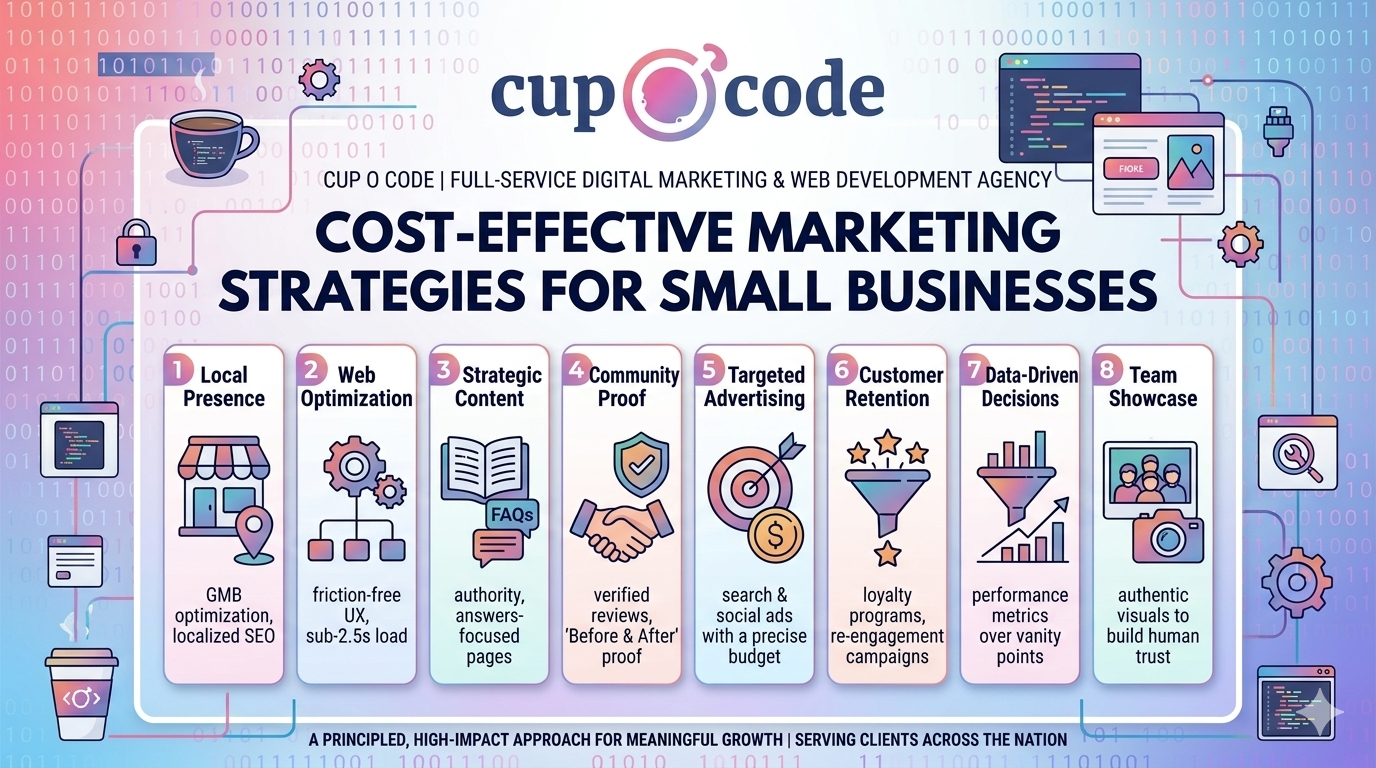
- Use social media marketing to build visibility and engagement without relying on big ad budgets.
- Use email marketing to nurture leads and drive repeat sales with direct, low-cost outreach.
- Use local SEO optimization to help nearby customers find you through search and maps.
- Use content marketing to create lasting value that attracts and educates potential customers over time.
- Use partnership marketing and customer referral programs to grow through trusted relationships and word-of-mouth.
Create Scroll-Stopping Images In-House With AI in 10 Minutes
Instead of hiring pricey graphic designers or photographers for every social post, blog graphic, or basic ad, you can create engaging AI-generated images in-house to support your business’s marketing needs. A text-to-image tool lets you turn a short description into a ready-to-use visual, which can streamline the process of creating visual content to promote your brand, especially when you need options fast. If you want a practical example to try, AI text-to-image creation by Adobe Firefly is one way to generate AI images for those everyday marketing visuals.
Pick Low-Cost Tactics That Actually Bring Customers Back
If you’re trying to grow without a big ad budget, you’re not stuck. The best budget-friendly marketing strategies usually do two things well: they get attention and they give people a reason to return.
- Turn one offer into a “comeback” sequence: Create a simple customer retention method that runs automatically: Day 0 thank-you message, Day 7 how-to tip, Day 21 reminder + small perk. Retention matters because acquiring a new customer is 6 to 7 times costlier than retaining an existing one, so even small improvements can pay off. Example: a service business emails “How to keep results longer” plus a 10% rebook bonus that expires in 7 days.
- Host a tiny community engagement event you can repeat monthly: Pick a consistent theme like “First Friday” demos, Q&A hours, or a neighborhood clean-up with coffee. The goal isn’t a huge turnout, it’s familiarity and local word-of-mouth. Example: a gym runs a free 30-minute form check each month and hands attendees a buddy pass.
- Use AI-made visuals to post weekly “before/after” proof: You already know how to create scroll-stopping images fast; now give those images a job. Build a weekly post template: problem → outcome → one clear call-to-action. Example: a home organizer posts an AI-designed carousel showing “Cluttered Pantry → 15-Minute Reset” and links to a single booking page.
- Run a guerrilla marketing “micro-stunt” that points to a QR code: Keep it respectful and allowed, but surprising enough to be shareable, sidewalk signs (where permitted), a pop-up photo spot, or a simple “mystery discount” posted near your storefront. The QR code should lead to one action: join a list, claim a sample, or book a consultation. Example: a café puts a “Flip this card for your secret menu item” stack at nearby partner counters.
- Create a referral loop that rewards both sides instantly: Don’t wait for a complicated points program; start with one clear rule and a reward that’s easy to redeem. Example: “Give $10, get $10” or “Free add-on for both of you” delivered at checkout. Keep it visible on receipts, thank-you emails, and a small counter sign.
- Partner with a complementary local business for a ‘bundle’ week: This is low-cost advertising tactics without paying for ads: you borrow trust from a neighboring brand. Agree on one shared audience, one bundle, and one week of promotion each. Example: a salon partners with a boutique, customers who buy a gift card get a styling discount, and both businesses cross-post the same AI-made promo graphic.
- Re-activate past customers with a “use it or lose it” value add: Pull a list of customers from 60–180 days ago and offer something that’s helpful, not just cheaper: a free check-in, a refresh service, or a new feature preview. Example: a lawn service offers a free “season readiness” inspection slot for prior clients who book this week.
Pick → Schedule → Execute → Review
This workflow turns your low-cost ideas into a repeatable marketing plan workflow you can run even on busy weeks. It keeps strategy prioritization clear, makes campaign scheduling realistic, and gives you a built-in moment to adjust before you waste effort. Think of it like the routine a satisfied customer feels: consistent touchpoints, clear next steps, and fewer random surprises.
| Stage | Action | Goal |
| Choose one focus | Pick one offer and one audience segment for this cycle | Fewer moving parts, clearer messaging |
| Map the cadence | Schedule two outbound touches and one follow-up | Consistent visibility without overwhelm |
| Build simple assets | Draft one template, one visual, one landing action | Faster publishing and easier reuse |
| Run the week | Execute tasks, track replies, clicks, bookings | Proof of what creates momentum |
| Review and adjust | Note wins, drop friction, refine next week’s plan | Steady improvement with less guesswork |
Each stage supports the next: focus prevents scatter, scheduling protects time, and assets make execution lightweight. The weekly review closes the loop so your step-by-step marketing execution gets sharper, not louder. Start small, stay consistent, and let the results guide your next cycle.
Building Budget-Friendly Momentum That Leads to Real Business Growth
When budgets are tight, it’s easy for marketing to turn into scattered posts and one-off promos that don’t stick. The steady Pick → Schedule → Execute → Review mindset keeps decisions simple and makes cost-effective marketing success repeatable, so small business marketing impact comes from focus, not spend. Over time, sustainable customer engagement turns into stronger customer retention outcomes and real long-term marketing benefits that support your broader business growth strategies. Consistency beats complexity when the budget is small. Pick one priority, schedule the next two weeks, and run the cycle once with honest review. That rhythm builds resilience and dependable growth even when resources stay lean.