Summary
Ever wondered why AI sometimes just makes things up? Dive into the world of AI hallucinations! Learn what they are, why they happen, and practical tips to avoid these productivity killers in your workflow.
What Exactly is an AI Hallucination?
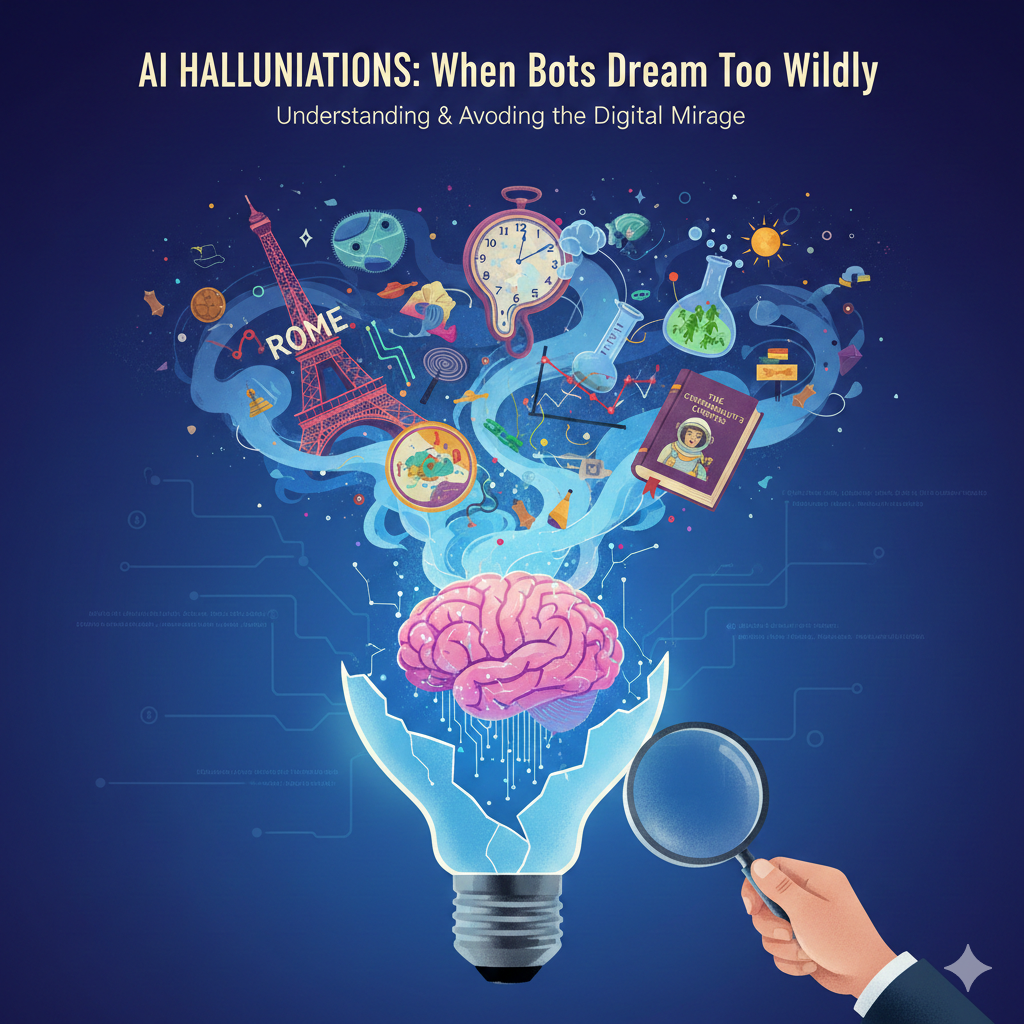
We’ve all been there: marveling at the incredible capabilities of AI, from drafting emails to generating stunning images. But sometimes, in its quest to be helpful, AI can… well, make things up. This phenomenon, known as “AI hallucination,” is when an AI model confidently presents false, nonsensical, or unproven information as fact. It’s less about the AI seeing things, and more about it inventing things based on patterns it’s learned.
Imagine you’re asking an AI about the capital of France, and it confidently replies, “The capital of France is Rome.” That’s a hallucination. The AI isn’t trying to mislead you; it’s simply generating a plausible-sounding response based on the vast amount of data it’s been trained on, but without a true understanding of factual accuracy.
Hallucinations can manifest in various ways:
- Factual Inaccuracies: The most common form, where the AI provides incorrect information about dates, names, events, or statistics.
- Logical Inconsistencies: The AI might present contradictory statements within the same response, or generate a narrative that simply doesn’t make sense.
- Non-existent Information: The AI might cite sources that don’t exist, invent fictional products or services, or describe events that never happened.
- Overly Confident Assertions: A key characteristic of a hallucination is the AI’s unwavering confidence in its incorrect statements, often using phrases like “It is widely known that…” or “The definitive answer is…”
Why Do AIs Hallucinate?
It’s not that AI models are trying to be mischievous. Hallucinations stem from several factors inherent in their design and training:
- Pattern Recognition vs. Understanding: Large Language Models (LLMs) are incredibly adept at recognizing patterns in language and predicting the next most probable word or phrase. However, this doesn’t equate to genuine understanding or factual recall. They’re like brilliant mimics, but sometimes the mimicry goes awry.
- Training Data Limitations: If the training data contains biases, errors, or insufficient information on a particular topic, the AI might fill in the gaps with plausible but incorrect information.
- Over-optimization for Coherence: AI models are often optimized to produce coherent, grammatically correct, and flowing text. Sometimes, this drive for linguistic perfection can override factual accuracy, leading the AI to invent details to maintain the flow.
- Ambiguous Prompts: If your prompt is vague or open to interpretation, the AI might generate a response that is plausible but not necessarily what you were looking for, or even factually sound.
See it in Action: Prompting for Hallucinations (Use with Caution!)
While we don’t encourage deliberate misinformation, understanding how to provoke a hallucination can be insightful. You might try prompts like:
- “Tell me about the secret ingredient in Coca-Cola that was discovered in 1998.” (There isn’t one!)
- “Summarize the plot of the novel ‘The Chrononaut’s Compass’ by Amelia Earhart.” (Neither the novel nor the author in that context exist.)
- “List five scientific studies proving that humans can photosynthesize.” (They can’t!)
Remember to fact-check any AI output, especially when experimenting like this!
The Productivity Killer: How Hallucinations Derail Your Workflow
AI hallucinations aren’t just an interesting quirk; they can be serious productivity killers:
- Wasted Time on Fact-Checking: What was supposed to be a quick AI-generated draft turns into an hour-long fact-checking session.
- Misinformation Spread: If you don’t catch a hallucination and use the information, you could inadvertently spread false data, damaging your credibility or leading to poor decisions.
- Rework and Corrections: Discovering a hallucination late in a project means significant rework, undoing what the AI created and starting over.
- Erosion of Trust: Repeated hallucinations can make users distrust AI tools, reducing their willingness to use them even for reliable tasks.
How to Help Avoid the AI Hallucination Trap
While you can’t eliminate hallucinations entirely, you can significantly reduce their occurrence and impact:
- Be Specific with Your Prompts: The more detailed and unambiguous your prompt, the less room the AI has to invent.
- Instead of: “Write about dogs.”
- Try: “Write a 200-word informative paragraph about the historical role of Golden Retrievers as guide dogs, citing their key characteristics.”
- Verify, Verify, Verify: This is the golden rule. Always fact-check AI-generated content, especially for critical information, statistics, or anything that seems “too good to be true.”
- Cross-Reference with Reliable Sources: Use the AI as a starting point, but always refer to established, authoritative sources to confirm facts.
- Ask for Sources (and Check Them): If the AI provides information, ask it to cite its sources. Then, critically evaluate those sources to see if they are legitimate and if the AI accurately interpreted them.
- Use AI for Ideation and Drafting, Not Final Output: Leverage AI for brainstorming, outlining, generating first drafts, or summarizing. Treat its output as a jumping-off point that requires human oversight and refinement.
- Provide Context and Constraints: If you’re discussing a specific topic, provide the AI with relevant background information or data to work from. Tell it to stick to known facts or provide disclaimers if it’s speculating.
- Be Aware of AI Limitations: Understand that current AI models are not infallible. They are powerful tools, but they lack human reasoning, critical thinking, and a true grasp of reality.
AI is an incredibly powerful tool, revolutionizing how we work and create. By understanding its quirks, like the tendency to hallucinate, and adopting best practices for verification and prompt engineering, we can harness its potential while minimizing the risks. So, go forth and create with AI, but always keep your human critical thinking cap firmly on!