Summary
Is OpenAI buying Pinterest? Explore the rumors and the rise of the P.I.N.N.E.D. Effect—where AI-generated hallucinations create false expectations for reality. Learn why this merger could either trap our creativity or finally break us out of the "vessel of the known" to build the impossible.
The rumors are officially white-hot. Industry insiders are pointing to a massive move by Sam Altman: OpenAI is reportedly looking to acquire Pinterest. According to the latest 2026 intelligence from The Information, Pinterest has emerged as the ultimate “data whale” for OpenAI to swallow.
The logic is simple: OpenAI wants those 200 billion+ human-curated images to train their video-generation models and turn ChatGPT into a visual shopping engine. But beneath the corporate strategy lies a much deeper shift in how we relate to our own creativity.
Beware the P.I.N.N.E.D. Effect
As we blend the worlds of reality and AI, we’re stumbling into a psychological trap. We call it getting P.I.N.N.E.D. > P.I.N.N.E.D.: Physically Impossible Nonsense Normalizing Excessive Delusion.
For years, Pinterest was a digital scrapbook for the “real.” You pinned a deck you could build or a dress you could buy. But with OpenAI at the helm, your feed will increasingly be populated by “synthetic perfection”- images that look flawless but ignore the laws of physics and the realities of your bank account.
When you get P.I.N.N.E.D., you start holding your real life to the standards of a hallucination. You find yourself frustrated that your local contractor can’t build a floating marble staircase that defies gravity, or that a sunset in your backyard doesn’t have the “neon-pastel” hue of a generated landscape. We are creating false expectations of projects and lifestyles that literally cannot exist in three dimensions.
The Silver Lining: Breaking the “Sailing Ship” Trap
However, there is a reason to be genuinely excited about this potential merger.
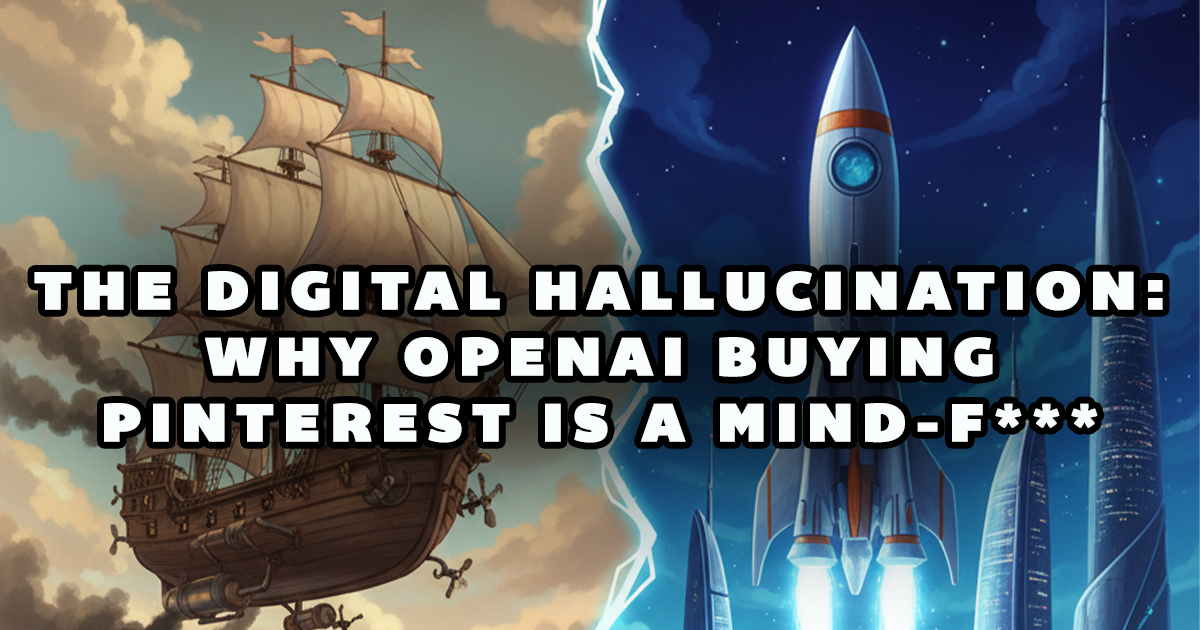
Historically, human imagination has been limited by what we already see. In the 19th century, when artists tried to imagine the future of travel, they didn’t draw rockets – they drew flying sailing ships. They took the only vessel they knew and tried to make it fly. They were trapped by the “vessel of the known.”
The true power of an AI-integrated Pinterest is its ability to shatter that vessel. By showing us things that don’t exist yet, it breaks our brains out of the “search for what’s available” mindset and forces us into the “imagine what’s possible” mindset.
If we use this tool correctly, we aren’t just looking for a new coffee table; we are looking for a shape we’ve never seen, a material we haven’t invented, or a way of living that hasn’t been coded into a catalog yet. It moves us from being mere consumers of the present to being architects of a future we haven’t even dared to name.
The danger is the delusion, but the opportunity is the evolution. If we can avoid getting P.I.N.N.E.D. to a false reality, we might finally start building the rockets instead of just adding more sails to our old ships.