Summary
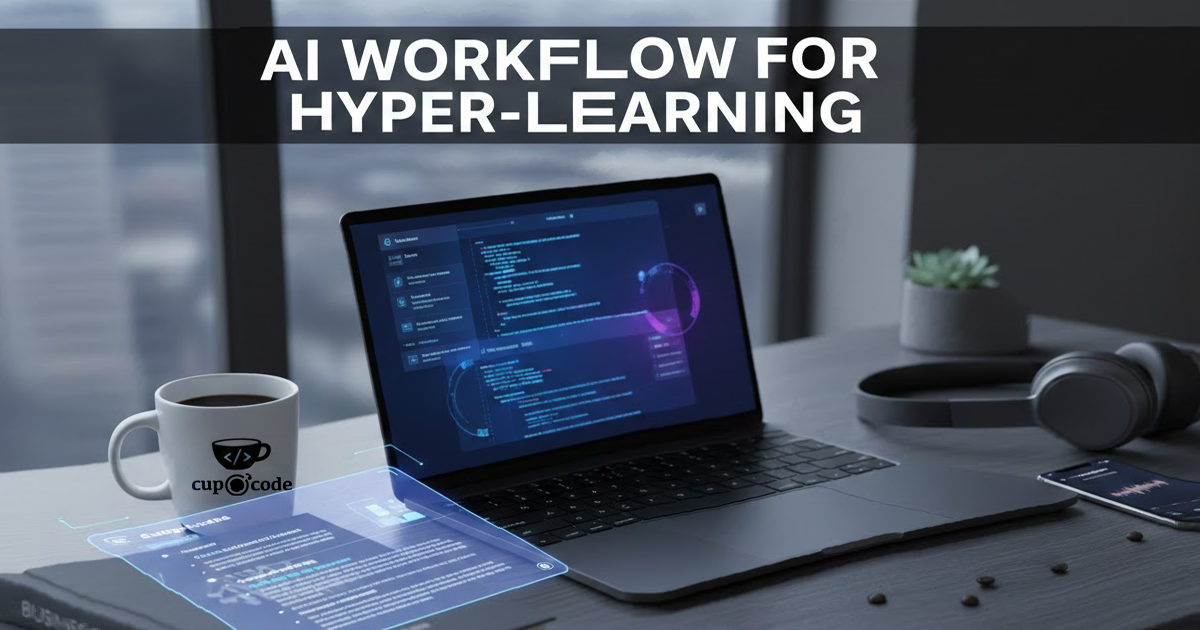
This post breaks down a modern approach to learning in an information-saturated world. Instead of passive, linear reading, it introduces a structured AI-first workflow: using Gemini to filter for value, NotebookLM to extract technical "if/then" strategies, and transformation tools to turn text into actionable business SOPs. It is about moving from "finishing pages" to "implementing insights."
We have all been there. You buy a 300-page business book with the best intentions. You read it cover to cover, highlight a few quotes, and then six months later you cannot remember a single actionable takeaway.
In the age of AI, reading line by line is inefficient. As developers and agency owners, our most valuable asset is time. We do not need more “pages read” stats. We need insights that move the needle.
We recently looked into a framework by Nitin Sharma that flips the script on how we consume information. Here is how to apply a Cup O Code efficiency boost to your reading list.
The Problem: The 80/20 Rule of Padding
Most non-fiction books follow a predictable pattern: 20% original insight and 80% repetition, anecdotes, and fluff designed to help humans process information. While stories are great for entertainment, they are a bottleneck when you are trying to master a new SEO technique or understand a complex API.
The goal is not to read faster. It is to extract with intent.
Step 1: Interrogate Before You Invest
Before you crack the spine or open the PDF, put the book on trial. Use a tool like Gemini or ChatGPT to justify why this book deserves your time.
The Prompt:
“I am a digital marketing agency owner focusing on local SEO and WordPress development. Based on the book [Title] by [Author], provide a high-level summary of the core thesis. Identify the 3 most unique frameworks mentioned. List 5 specific types of people who should avoid this book because the content would be too basic for them.”
This creates a mental map before you start. It allows you to focus on the meat of the content.
Step 2: The Consultant Extraction
Once you confirm the book is worth your time, move it into a tool like NotebookLM. This is useful for technical research because it limits the AI’s knowledge to only the text you provide. Instead of reading passively, you treat the book like a consultant you hired.
The Prompt:
“Analyze this document and extract a list of every actionable ‘if/then’ statement. For example, ‘If you want to increase site speed, then minimize these specific scripts.’ Focus on technical execution and business scaling strategies. Ignore the introductory anecdotes in the first three chapters.”
Step 3: Transform for Retention
Reading is not always the best way to learn. Our brains thrive on patterns and varied formats. Use AI to transform text-heavy pages into something else:
- Audio Overviews: Generate a “Deep Dive Conversation” in NotebookLM to listen while you are commuting.
- Quizzes: Use a prompt to test your actual understanding of the concepts.
- Visual Summaries: Convert complex chapters into bulleted frameworks or SOP outlines.
The Prompt for a Quiz:
“Using the uploaded source, create a 10-question technical quiz. 5 questions should be multiple choice and 5 should be ‘how-to’ scenarios where I have to apply a framework from the book to a client project. After I answer, provide the correct reasoning based on the text.”
The Cup O Code Takeaway
Finishing a book does not equal learning. Applying one single idea to your business is worth more than reading 1,000 pages and doing nothing.
The Workflow Summary
- Filter: Use Gemini to decide if the book is worth your hours.
- Extract: Use NotebookLM to find the non-obvious, actionable gems.
- Transform: Turn the data into a format that sticks (audio or quiz).
- Apply: Turn the results into a 5-step SOP for your next project.
Stop playing the old game of passive reading. Use AI to do the heavy lifting so you can focus on thinking, connecting, and building.